
A Non-productive treasurer
March 23, 2026
The Treasurer has finally delivered what might be the most honest economic statement of the Albanese Government to date: productivity growth will not return until 2031.
Not delayed. Not slower than expected. Effectively absent.
Five years is a long time in economics. It is also, conveniently, just far enough into the future that no one currently in office will be around to explain why it didn’t happen.
By 2031, of course, anything is possible. We might see a productivity rebound. We might discover cold fusion. The Treasurer might even deliver the Government’s now-mythical $275 reduction in household electricity bills.
Hope springs eternal.
But productivity does not.
Productivity is not a vibe. It is the cumulative result of labour flexibility, managerial efficiency, and regulatory clarity. It rises when firms can reallocate resources quickly and organise work in ways that maximise output per hour.
Or, to put it in terms the current government might understand: productivity requires the exact opposite of what they have spent the last three years doing.
Start with the centrepiece: The expansion of multi-employer bargaining represents the most significant structural shift in wage-setting since the decentralisation reforms of the 1990s - only this time in reverse.
Under the new “supported bargaining” and “single-interest employer” streams, firms with fundamentally different business models, cost structures, and productivity profiles can be corralled into the same bargaining framework. The underlying economic assumption is extraordinary: that wages can be standardised across heterogeneous firms without regard to firm-level productivity.
This is not bargaining. It is wage cartelisation with legislative backing.
The predictable consequence is that high-productivity firms are disincentivised from innovating because they cannot fully capture the gains while low-productivity firms are pushed toward the margin. The system stifles differentiation and substitutes regulatory coordination for market signals.
If you were designing a system to suppress productivity growth, you would struggle to do better.
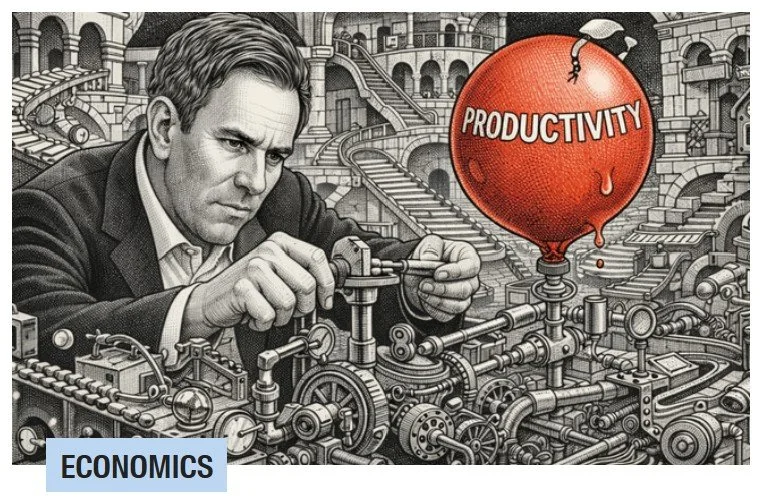
Then there is the small matter of the modern awards system - the industrial relations equivalent of a Rube Goldberg machine.
Take the General Retail Industry Award. It is not merely complex; it is combinatorially explosive. Thousands of pay rates determined by age, classification, employment type, time of day, day of week, and an assortment of allowances that read like historical artefacts from a long-forgotten economy.
The compliance task is no longer administrative; it is computational.
Large employers now require enterprise-grade payroll systems and external legal advice to understand it. Even then, inadvertent underpayments are not a risk but now common.
Hence the parade of household-name companies announcing “historical payroll discrepancies,” as though they had accidentally miscounted the petty cash rather than navigated a system with over a thousand legally distinct pay outcomes.
At this point, the most efficient reform would be to issue employees with GPS trackers so employers can reconstruct their exact movements and calculate entitlements in real time. It would be less intrusive than the current system, and certainly more accurate.
Overlay this with the explosion in general protections claims - a jurisdiction so broad it borders on conceptual. Adverse action provisions invert the burden of proof, expand the range of actionable conduct, and render managerial decision-making a legally hazardous activity.
In most areas of law, intent matters. In general protections, it is often beside the point. What matters is whether a prohibited reason can be inferred, alleged, or creatively constructed after the fact.
The result is a litigation environment characterised by asymmetry: low cost for applicants, high cost and high uncertainty for respondents. Rational employers settle. Rational managers hesitate. Rational firms avoid risk.
And productivity, which depends on decisiveness, restructuring, and sometimes difficult personnel decisions, quietly deteriorates.
Unfair dismissal laws add another layer. Not as a safeguard against impulse, but as a procedural minefield. Employers must not only have a valid reason but they must demonstrate that every step of the process adhered to an evolving and highly particularised standard of “fairness.”
The system does not prevent bad decisions. It penalises imperfect ones.
Layer upon layer, reform upon reform, the cumulative effect is unmistakable: a labour market that is less dynamic, less responsive, and less capable of reallocating resources to their most productive use.
None of this is accidental.
It reflects a coherent policy preference: that equity should be pursued through forecast regulation of workplace outcomes rather than ex post redistribution through the tax and transfer system.
The problem is that when you attempt to hard-code fairness into every employment interaction, you do not eliminate trade-offs. You embed them. You fossilise them. And you make adjustment exponentially harder.
That is what the Treasurer’s 2031 admission really signifies.
It is not that productivity has been elusive. It is that the policy settings required to generate it have been systematically dismantled.
And yet, the political economy of the system makes reversal unlikely. Each new entitlement creates a constituency. Each new regulation creates a compliance industry. Each new complexity justifies another layer of interpretation, guidance, and enforcement.
The machine sustains itself.
So we are left with targets set a decade away, reforms that entrench the problem, and an economic narrative that treats productivity as an external variable - something that happens to us, rather than something we shape.
By 2031, we may well hit the numbers.
But if we do, it will not be because we fixed the system.
It will be because, eventually, reality forced us to.
And perhaps - just perhaps - your power bill will be $275 lower.
I wouldn’t bet on it.
James Mathias
Executive Director
