The Unions Are Emboldened. Labor Made Sure of It.
The Unions Are Emboldened. Labor Made Sure of It.
A union just told you it plans to shut down the country. The frightening part? They've barely started.
There is a particular kind of candour that ought to stop a nation in its tracks. Last year, Transport Workers' Union national secretary Michael Kaine stood before his members and described, with evident pride, a plan eight years in the making.
The union had deliberately engineered the simultaneous expiry of some 200 enterprise agreements across Qantas, Linfox, Toll, Virgin, Amazon, Cleanaway, Aldi, Qube and more to land, all at once, with what he called "the largest co-ordinated industrial campaign in the sector's history."
If employers didn't fold, the threat was explicit; the union was "prepared to shut down Australian transport. From airports to highways, from distribution centres to city streets."
Remember the 1989 pilots’ dispute? It grounded domestic aviation for fifteen weeks at which point the government declared a national emergency and had to send RAAF jets to fly civilian routes. Tourism lost more than $600 million, Some 22,000 workers were stood down and the economy took a billion-dollar hit. History often repeats itself.
Back to the words of Kaine. A union boss is openly boasting that he had spent the better part of a decade building the machinery to bring the nation's logistics to a standstill - and timing the detonation, by his own account, to "seize the moment" of Labor's election win. He even had a phrase for it: "positive militancy."
That spirit of positive militancy is now loose in Australian workplaces. And the numbers say it is no idle threat.
In the year to March 2026, Australia lost more than 200,000 working days to industrial disputes. A year earlier, the figure was 136,000.
That is a surge of nearly 50 per cent in twelve months.
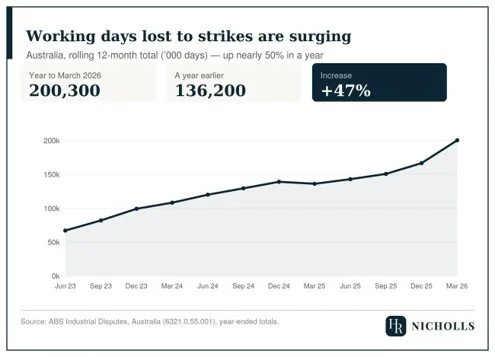
The annual tally has now climbed for four of the last five quarters.
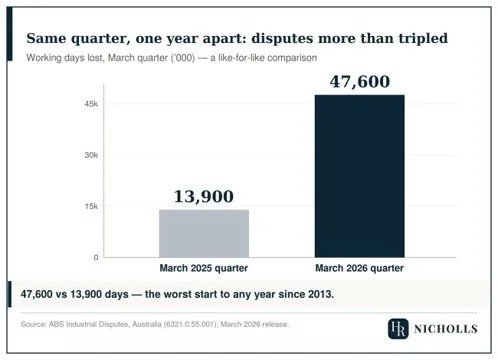
The March quarter alone was the worst start to any year since 2013 and on the rolling measure, you have to go back well over a decade for disputation sustained at this level. The graph has not drifted; it has lurched upward.
And it has stopped being a statistic.
As I write, BHP, the company underwriting a vast share of this nation's prosperity, is staring down a strike at Port Hedland where it warns the cost could be in the vicinity of $126 million a day in lost iron ore exports, much of it bound for our largest trading partner.
BHP has been reduced to texting electricians, offering $93 an hour, begging for a replacement workforce to keep the ore moving. At the very same moment, strike action at INPEX's Ichthys gas project is delaying cargoes promised to Japan and South Korea. We are, quite literally, threatening to cut off the customers who keep the lights on.
BHP's own verdict on why? It believes this wave of disputes was stoked directly by the Albanese government's industrial relations changes, including the new rules that let union officials walk into a workplace to recruit even where they represent barely a soul.
I agree.
And this is what brings us to the heart of it and to the part that should genuinely frighten you.
These figures, alarming as they are, are being racked up before the government's new industrial machinery has even been switched on properly. Consider what has been built in just three years.
Multi-employer bargaining - letting a single union drag multiple, separate employers into one negotiation and strike across all of them at once.
Easier right of entry.
A new "intractable bargaining" power.
The abolition of the construction industry watchdog, the one cop that had been prosecuting the CFMEU and winning millions in penalties, removed from the very sector that is our second-largest source of lost days.
And now, buried in a fresh bill, a proposal to let Canberra funnel its $105 billion procurement budget toward firms that strike union deals, a scheme business groups calculate would sideline 99 per cent of employers, who have no enterprise agreement at all.
Sign with a union or lose the government contract. That is not bargaining, that is extortion with a statutory license.
Here is the staggering thing: the Fair Work Commission's own data shows the flagship new weapons are still barely drawn. The multi-employer streams have been used a couple of dozen times a year, against thousands of ordinary agreements.
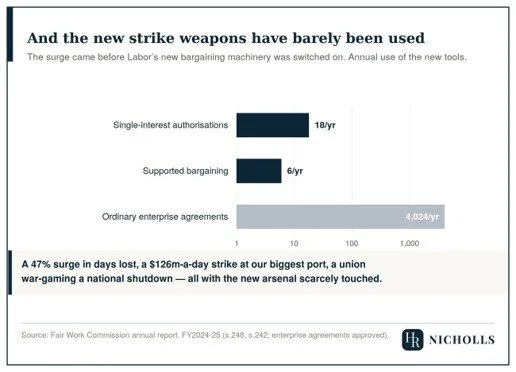
The strike ballots that precede most legal walkouts have, if anything, fallen. In other words, we are seeing a 50 per cent surge in days lost, a $126-million-a-day strike at our biggest port, and a union openly war-gaming a national transport shutdown, and the new arsenal has scarcely been touched.
Make no mistake, this is not the peak, this is the calm. This is the warm-up.
The engine is built, bolted into the economy, fuelled and idling and the people behind the wheel have told us, on the record, that they intend to floor it.
It will only get worse from here. You cannot hand organised labour a suite of powerful new tools, signal unmistakably that the umpire now barracks for one side, and then express astonishment when the tools get used.
The unlimited strikes of the 1980s did not arrive in a single year. They were built quarter by quarter, dispute by dispute, on a scaffold of laws and incentives that made mass industrial action easy and rewarding. That scaffold is being erected again, right now, in plain sight.
A union that aligns 200 agreements to expire on a single day and boasts about it does not generate more disputes, it generates one colossal one. One where the country buckles.
And who pays when it buckles?
Not, the public sector where union power now shelters - barely one private-sector worker in twelve still carries a union card. It is the productive private economy that wears it: the iron ore that doesn't ship, the freight that doesn't move, the family businesses with no reserves left to survive a week of chaos.
It all rests on an economy that is already grinding through six years of flat productivity and going backwards in output per person.
The unions, to their credit, are not bothering to hide. Mr Kaine has his 200 agreements loaded and waiting.
The threats are no longer whispered in back rooms, in modern day Australia under the Albanese Government, they are announced from conference podiums and printed in the newspaper. They have told us precisely what is coming, plainly and proudly.
The only question left is whether the rest of us are listening and whether a government that built this machine, and is now paying, privileging and protecting the people who operate it, will own what it has done before the bill lands.
The warning lights aren't flashing on some distant dashboard.
They are words, spoken aloud, by the people with their hands on the switch. Believe them and understand that everything we have seen so far has been with the safety still on.
HR Nicholls was established to fight tooth and nail against these plays to destroy our economy and way of life, and it is exactly what we are gearing up to do now.
Just last week we were the first Australian think tank to release the detailed modelling on the average costs to employers for each unfair dismissal claim and show the once again damming indictment on the Albanese Government who have caused claims to rise 76 per cent in three years.
Two weeks prior, another report was released exposes the fair work system undercutting Australian employers by creating a system where you can overpay your employees but be found guilty of underpaying them.
The IR debate is at the centre of Australia’s economy and we will continue to push for significant reform to keep our economic prosperity.