Submission for NES inquiry
The submission can be downloaded from the following link.
Dear Committee Members,
The legislated working arrangements of Australians are multi-layered and prescriptive. There are many benefits in years of hard-fought employment gains and, in a sophisticated and modern society like Australia these gains, seen as national minimum workplace rights, are what add to this country’s appeal.
The National Employment Standards (NES) create minimum entitlements in workplaces that apply regardless of an award or enterprise agreement, with these rights enshrined to ensure they cannot be taken away but also take precedence over an award/enterprise agreement. Another benefit of the NES, as they are consistent across all employment and therefore an employer does not need to learn a new set of standards each time someone is employed to do a job under a different award.
However, any commonsense assessment of the Australian IR system, and its comparison to other advanced economies, means inquiring into the NES in a silo would be a mistake, as they form the bedrock for the uniquely complex awards and enterprise agreements in which they sit. These all combine to make Australia’s employment system the most complex in the world.
Australian Governments have spent more than 15 years making it increasingly difficult to employ people and pay them correctly. This over-complication is causing serious compliance issues that negatively affect both employees and employers.
Further, no clear boundary has been established to distinguish what should belong with the NES, as universal statutory minimums, and what then should be in awards. This as an issue has led to the now uncontrollable expansion of the prescriptive nature of awards. If this runaway train isn’t dealt with soon, there will continue to be employment and productivity related issues well into the future.
The overlap and repetition between awards and the NES, and between the NES and other legislation, means there is no hope of securing a clearer, more effective safety net until we address this fundamental failure in the system’s design.
What this means in practice
High-profile underpayment cases show that even Australia's largest and best-resourced organisations are making costly and long-standing mistakes in paying their employees. These organisations are not negligent or criminal; the employment system is simply too complex and overlapping, to be reliably navigated, even for those with substantial resources.
Small businesses face an even more difficult challenge. They have little chance of consistently complying with a system that baffles even the nation's top employment lawyers, specialised law firms, charities, and the federal department responsible for workplace legislation.
It should not take $100 million in taxpayer funds for unions, and indeed employer groups, to “explain” and “engage” with recent reforms to Australia’s workplace laws. If anything, this confirms that Australia’s workplace laws are far too complex.
A typical award-covered employer, such as a small, suburban shop owner, is required to understand and accurately apply an eye-watering range and level of different employment obligations.
If the experts have been caught underpaying employees, what chance does a small business owner have?
The vast majority of employers make genuine efforts to comply with their legal obligations, despite the system's complexities and lack of regulatory coherence. When so many are unintentionally getting it wrong, either by underpaying or overpaying, the rules clearly need re-examination.
International Comparisons
Unlike other nations with a single or minimal minimum wage, Australia prescribes multiple wages based on industry, workplace, occupation or type of employment. Other countries simply do not approach minimum standards, or minimum pay for work anywhere near our level of complexity or prescription.
➔ The UK sets a single ‘National Living Wage’ with three age-based proportionate rates, an apprentice rate, and an accommodation offset.
➔ France sets its SMIC minimum wage as a single monthly rate with 12 separate parameters. That’s 12 minimum wages for a country of 67 million people and the world’s 7th largest economy.
➔ New Zealand has a single minimum wage, and did away with its award system in the 1980s.
➔ The US and Canada have separate national and state (provincial rates) and may prescribe some different rates for particular industries or for particular hours. This is generating minimum wages in the dozens at most in any jurisdiction, not in the tens of thousands.
➔ Spain, an economy of roughly equivalent size to Australia’s, though with a much larger population, prescribes three separate minimum wages: a general rate, a daily rate for temporary and casual employees, and a rate for home service workers.
Award Complexity
The seven most common awards have an average of 36 classifications each and if extrapolated out, we would have a separate wage for every 3,347 employees in Australia. This heavy reliance on narrowly-defined classifications adds incredible layers of complexity to Australia’s wage structure.
This is of course conservative as modern awards prescribe exponentially more minimum wages than it first appears.
With overtime, different rates for different hours, for work on different days, and different rates for different types of employment, awards aren’t imposing 36 minimum wages per industry or occupation, they are imposing hundreds or even thousands of minimum wages.
The FWO publishes pay guides in an attempt to assist employers and employees in understanding and applying Australia’s complex system of numerous and narrowly differentiated minimum wages. These pay guides starkly illustrate just how many separate pay obligations Australia is imposing.
The pay guide for the Hospitality award alone runs to 82 pages of tables of separate minimum wages which employers must observe under pain of substantial penalties and back pay, which apply in addition to a 175-page award. A conservative calculation finds the pay guide for this award alone having at least 5,000 separate minimum wages.
This award since being instituted on the 30th of December 2009 has had 74 separate versions and 91 variations.
Then there is the General Retail Industry Award – It has 8 classifications, spanning 3 types of employment, 10 different rates relating to apprentices, 7 rates for different ages of causals, 7 different rates for different ages of permanent employees. These different rates then break down into different shifts, overtime rates and then shift workers. Overall, it results in 1,424 different rates of pay detailed across 119 pages and over 26,000 words.
This award has been updated 83 times since 11 September 2009 and from 2015 to 2026 has grown from just 69 pages to nearly 120.
Within this award it has been determined by someone, somewhere, that a second-year apprentice completing a 4-year tenure who did complete year 12 is paid $1.41 per hour more than the person doing the same job who did not complete year 12.
A junior casual employed for less than 6 months and who is 20 years old working their first 3 hours of overtime from Monday to Saturday is paid $4.63 less per hour than the person doing the same job, under the same conditions, but who has worked for longer than 6 months.
If they work on Sunday, the difference is $5.96 per hour.
A full time or part time adult working as a retail employee on a level one classification baking bread in the morning is paid $4.65 less than the exact same person doing the exact same job but in the evening.
In addition, if a business is seeking to employ someone, they must ensure they are compliant with the NES as a condition of entering into that arrangement. If they were to read every single summary fact sheet provided by the Fair Work Ombudsman, they need to be across 49 pages.
The 12 National Employment Standards in the Fair Work Act, run to 100 pages and more than 25,000 words.
This is absurd.
How could a workforce less than the population of New York or Tokyo need thousands upon thousands of separate wages when they get by with simple and coherent structures?
Then we approach the issue of overlapping entitlements.
Clause 17.5 of the Clerks - Private Sector Award (Clerks Award) stipulates that where an employee is terminated, the employer must pay the terminated employee any wages, and entitlements arising under the award or NES within 7 days of termination.
Annual leave is provided for in clause 32 of the Clerks Award but also in the NES. The NES requires that on termination the untaken annual leave must be paid out on termination (90(2)). This is a contradiction with the above clause.
Any experienced employment lawyer would know to ignore the incorrect advice provided in the award, as the NES takes precedence, however, it is understandable how employers can, and have, made mistakes of this nature.
The Imperative Need for Action
Supporters of the current system argue that the extensive regulation is necessary to deliver better outcomes for Australian workers. They might even claim that Australia’s approach to multiple minimum wages and highly prescribed conditions makes the country fairer and more beneficial for working people and the broader community.
The dirty secret in the 21st century is that Australia’s highly complicated and prescriptive approach to regulating employment doesn’t actually deliver fairer or better outcomes than the far simpler approaches taken in other developed countries.
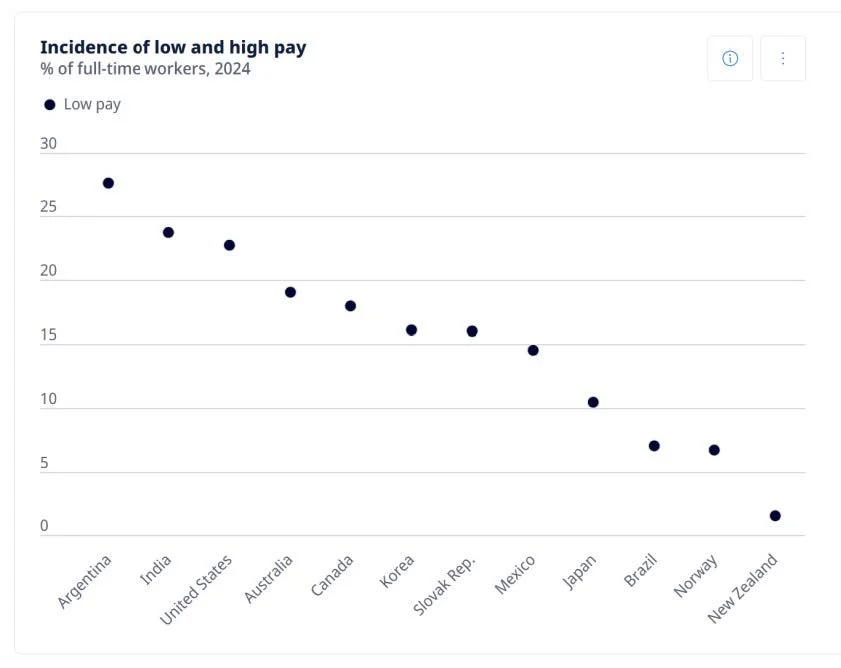
Australians do not enjoy significantly better pay than their counterparts in many comparable countries, including those prescribing much simpler minimum wage structures. The incidence of low pay in Australia is higher than the overall Japan, Canada and New Zealand, but lower than the United States.
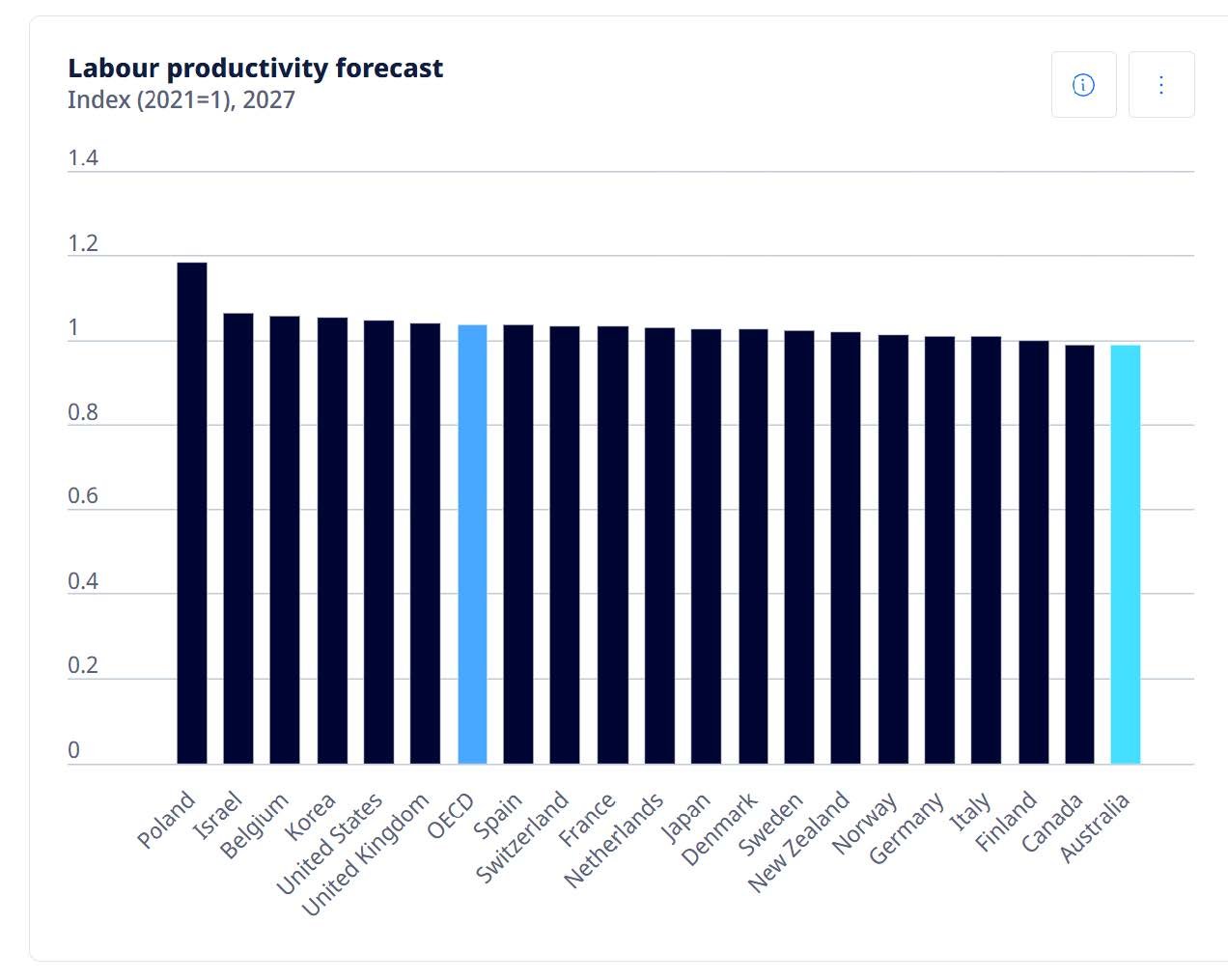
Australia’s productivity forecast is disappointing, ranking below the OECD average, and below Israel, the US, Switzerland the UK, and New Zealand. Australian labour productivity seems mired at 2015 levels, which fits with the decline of enterprise bargaining since the Fair Work Act.
Conclusion
The more complexity in an industrial relations system (beyond a certain point), the higher the risk to employ. The higher the risk to employ, the less likely employment is, and even less likely than that is productivity growth.
We are free to marry whomever we choose; free to have children and bring them up; free to attend or not attend any church and practice any religion; free to buy houses, cars, businesses and whatever the market indicates but we are not free to arrange our own relationships with employers beyond simple national standards. Those relationships are prescribed for us in great detail, on the grounds that if they were not so prescribed, we would be grossly exploited and reduced to survival wages.
Employers in Australia feel as though they have a better relationship with hundreds of pages of legislation than their own employees. They must bemoan being more across the details of a phone book of pay scales than being on the tools with their employees, understanding how to grow their businesses.
The NES, though noble in their intent, and by initially being created to be comprehensive basis for the minimum rights and conditions of working Australians, has been used as a vehicle to imbed even more complexity in the system. You cannot have your cake and eat it too on prescriptive standards like these.
With this in mind, it is not logical to then embed them into tens of thousands of separate minima pay scales and make it nearly impossible to understand how to correctly pay employees.
The NES can form a future platform of award simplification by incorporating a more streamlined approach to minimum wages across industry’s, an an international standard, and do away with the absurdity we currently have in these 122 modern awards.
They are one of the few areas of the Fair Work changes that was sensibly titled, and that communicates to the Australian community what the regulation does. A reformed body of legislated NES should:
● Become the sole source for minimum conditions of employment.
● Operate as generic national standards, without differing requirements for different industries.
● Operate as simply and clearly as possible, with an emphasis on:
○ Comprehensibility and explicability to employers and employees.
○ Clarity on what is and is not required, or allowed, in relation to each NES.
Recommendation 1
● The National Employment Standards (NES) should be retained, but reorganised into two groups:
○ Core NES that should apply to all employment (including high income). This encompasses standards on parental leave, annual leave, personal and related leave, and public holidays.
○ Extended NES, beyond the core standards, restricted to those who earn under a prescribed amount or threshold.
● Both the Core and extended NES should apply as single, consistent, national and uniform standards. In contrast to the existing award system, there should be no industry, or occupational differentiation in the application of the NES.
Recommendation 2
● Each of the NES, both the core and extended NES, should clearly set out not only how it may not be applied, but also how it may be applied flexibly by agreement.
● There should be a single standard for any NES, and a single set of options for flexible application, that are able to be accessed by any employee (by agreement with their employer) working in any industry, at any earnings level.
Recommendation 3
● Any changes to the NES should be subject to an automatic review by the Productivity Commission (PC) of its performance, effectiveness and impact after a prescribed period, along with particular consideration of:
○ The extent to which any new or materially amended NES are able to be understood and complied with.
○ Any areas of the operation of new or amended NES that are giving rise to ambiguities, non-compliance or disputes.
○ Impacts on small businesses and their employees, being businesses that employ less than 50 people on an FTE basis.
● The PC should be required to publicly report on any proposed additions or substantial changes to the NES, before amending legislation is introduced into Parliament.