Or Curse?
Economics has the Phillips curve, the Laffer curve and Okun’s law. All three of which are currently relevant to our economy, but now, Australia can offer two new unique contributions to economics textbooks discovered in the most unlikely of places: the media releases of Jim Chalmers.
The first is the Chalmers curve. The more often the Treasurer talks about an economic indicator, the worse that indicator performs.
The second is Chalmers law. Once an indicator has deteriorated far enough, it is wiped from mention, with a lag of about a year.
The curve does the damage, and the law removes it from view before anyone has a chance to fix it. Together they are a lethal concoction for any economy and should be studied in the future as the sorry tale of a government that talks a problem into the ground, then changes the subject.
The methodology is simple: read all 576 media releases Jim Chalmers has issued since June 2022, the words within them, and plot them against the performance of the economy.
Start with productivity. He has used it 359 times over the period. In his first full financial year, 15 per cent of his releases mentioned it, which grew to 18 per cent the following year and 19 per cent the year after that. Last financial year however, this had more than doubled to 44 per cent.
The rate at which he says the word has risen 228 per cent in the three years that coincided with output per hour of work falling about 3 per cent below the quarter he became Treasurer, and more than 4 per cent below the year before he arrived.
The Productivity Commission, whose chair he appointed, says we are barely 1 per cent above the average of 2015 to 2019. The Chalmers curve strikes – the more he says it, the lower it goes.
Tax tells the same story. The share of his releases that mention tax has nearly doubled, from 25 to 47 per cent, and this year it’s his favourite word, appearing more than four times per release which is bad news under the Chalmers curve.
The tax take has risen to a record in dollar terms and the highest percentage in 20 years.
Inflation is mentioned in nearly four releases out of ten, year in, year out like clockwork.
Also, like clockwork, inflation is suffering from the Chalmers curve by being stubbornly high at 3.7 per cent and the Reserve Bank has raised the cash rate four times this year to its highest level in 15 years.
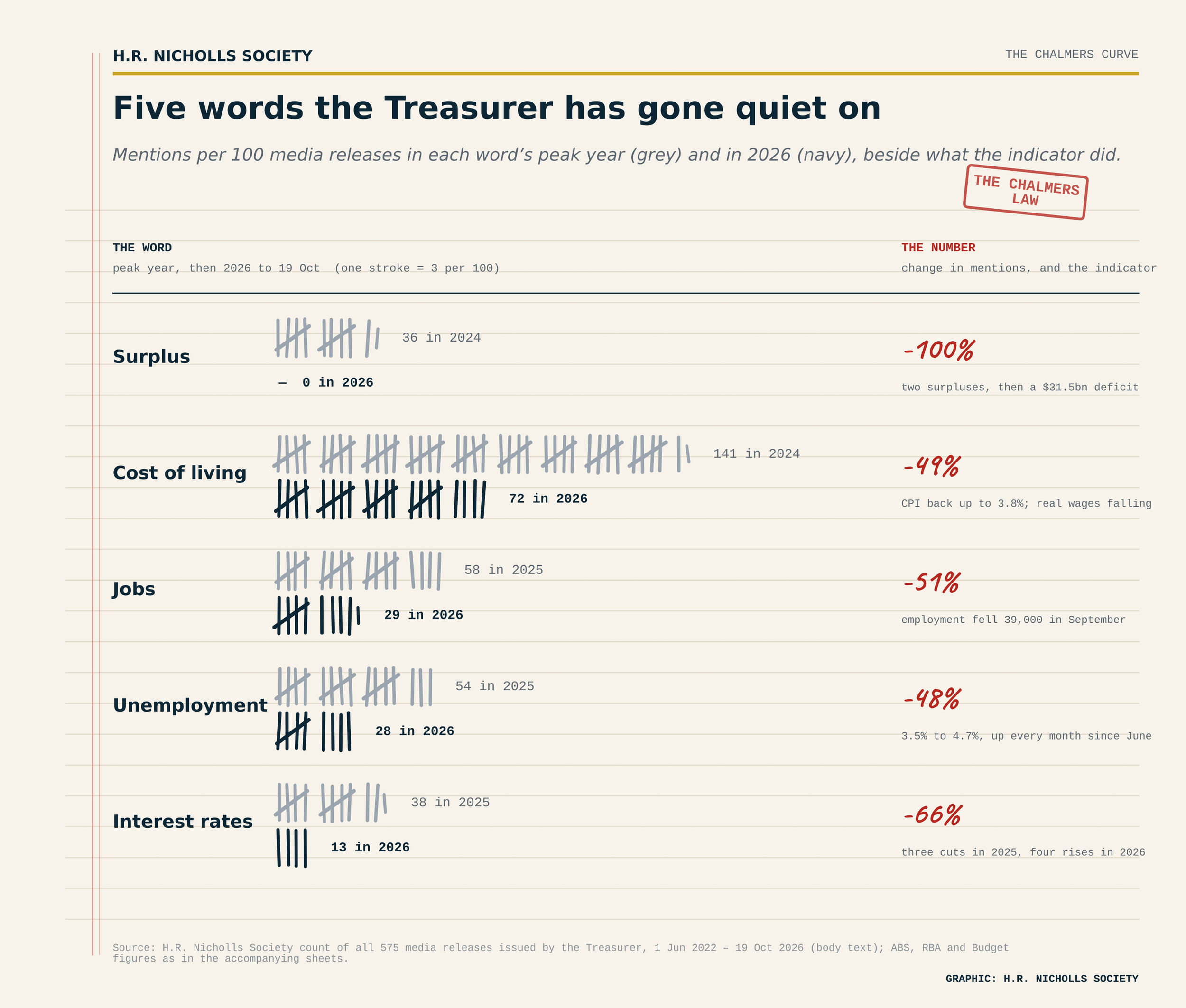
Now watch how the Chalmers law works.
Unemployment. The share of his releases mentioning it rose from five per cent in his first year to 29 per cent in 2025 when “unemployment remains low under Labor” was a release in its own right.
Unemployment was 3.5 per cent in his first full month and now it is 4.7 per cent. It has risen every month since June, and the number of times he mentions it has duly halved. The Chalmers curve and law in sequence.
Cost of living. In 2024 it was his busiest subject taking up 48 per cent of his releases.
Since then, the rate of mentions has halved, just as prices and mortgage rates turned back up. Real wages have now fallen, in annual terms, for three quarters running and are back roughly where they were in 2010. A worker on $90,000 is about $4,500 a year worse off than at the end of the pandemic, by the Australia Institute’s count.
The surplus. In 2024, 15 per cent of his releases mentioned it, in 2025, 5 per cent, and 2026? Zero.
Two surpluses, delivered by iron ore prices and bracket creep, have given way to a $22 billion deficit last year and $31 billion forecast for this one with gross debt passing a trillion dollars.
Just like the budget surplus, the word is now gone from his media releases.
These are the results of the freshly discovered economic principles of the Chalmers curve into Chalmers law, and it is consistent throughout every economic marker a household can feel. He increasingly talks about an indicator. It gets worse. He stops talking about it and it gets even worse quietly.
The one word that has not yet fallen silent is productivity, which on the curve either means that the worst is still to come, or that the silence is booked for 2027.